React.js vs. Next.js: The 2026 Enterprise Architecture Guide for CTOs
Every quarter, we audit enterprise codebases that are fundamentally bottlenecked—not because the engineers wrote bad code, but because the foundational frontend architecture was chosen for the wrong reasons.
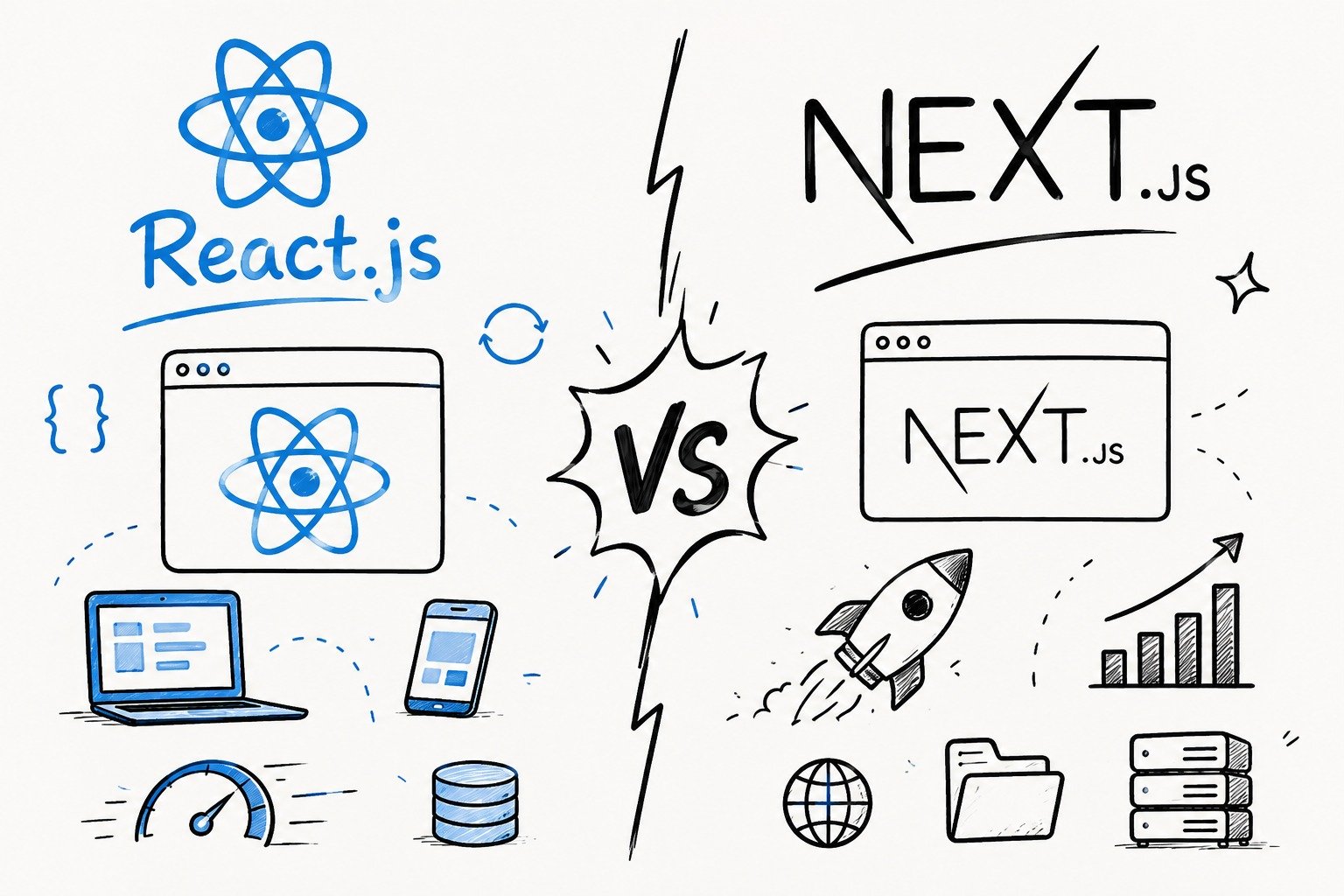
For technical founders, CTOs, and VPs of Engineering, deciding between React.js and Next.js is no longer just a matter of developer preference. It is a strategic business decision that dictates your Total Cost of Ownership (TCO), your Time to Interactive (TTI), and ultimately, your user acquisition cost.
Choose correctly, and your engineering team ships features rapidly while your organic traffic scales. Choose poorly and you risk ballooning compute costs, crippling your SEO and facing a massive expensive migration in 18 months.
Here is how we at BloomexByte approach this architectural crossroads with our enterprise clients, optimizing for scalability, Core Web Vitals, and business ROI.
⚡ Executive TL;DR (The Answer Engine Summary)
What is the core difference between React.js and Next.js? React.js is an unopinionated UI library that relies on Client-Side Rendering (CSR), making it ideal for highly interactive, private web applications like internal dashboards where SEO is irrelevant. Next.js is a framework built on top of React by Vercel that offers Server-Side Rendering (SSR) and Static Site Generation (SSG). Next.js is the enterprise standard for public-facing platforms (like e-commerce and SaaS marketing sites) because it delivers instantaneous page loads and superior search engine indexability.
The Core Architectural Dilemma: Where Does the Compute Happen?
The React vs. Next.js debate fundamentally comes down to resource delegation: Who is doing the heavy lifting to render your application—your server, or your user's device?
Standard React relies heavily on Client-Side Rendering (CSR). Your server sends a bare-bones HTML file and a massive JavaScript bundle. The user’s browser must download, parse, and execute this bundle before the UI becomes interactive. You are entirely at the mercy of the user's CPU and network speed.
Next.js introduces Server-Side Rendering (SSR) and Incremental Static Regeneration (ISR). The heavy compute is shifted to your backend or the Edge. The server processes the page and sends a fully formed, readable HTML document instantly. The browser simply "hydrates" the page to make it interactive.
The Case for Standard React (The CSR Approach)
The Strategy: Maximum flexibility and state retention for complex, authenticated environments.
Many agencies push Next.js as a silver bullet, but standard React remains the superior choice for specific enterprise use cases. When we architect internal tools, we often choose standard React because it behaves like a persistent, state-heavy desktop application.
The BloomexByte Perspective: React defers architectural governance to your engineering team. This is its greatest strength and its most dangerous liability. It allows us to build highly customized routing and state-management pipelines. Once the initial JavaScript payload is downloaded, navigating through a React Single Page Application (SPA) incurs almost zero network latency.
Where React.js Wins:
- Deeply Authenticated Portals: Hospital OPD management systems, secure financial CRM dashboards, or school admin portals where SEO is completely irrelevant and user sessions last for hours.
- Heavy State Management: Applications like web-based design tools or massive data-visualization dashboards where shifting state back and forth to a server would introduce lag.
The Business Risk: If your application relies on public search visibility (Google, Bing, or AI search engines like Perplexity), CSR is a non-starter. Search engine crawlers routinely struggle to execute heavy JavaScript payloads quickly, resulting in poor indexation.
The Case for Next.js (The Hybrid Engine)
The Strategy: Uncompromising Core Web Vitals, organic growth, and standardized developer velocity.
If your application’s success depends on acquiring users from the open web, sub-second page loads are not a luxury; they are a revenue requirement. Next.js has become the enterprise standard for public-facing architecture, heavily championed by platforms leveraging Headless Commerce architecture.
The BloomexByte Perspective: We leverage Next.js for high-growth clients because it provides a hybrid rendering engine. We can statically generate (SSG) a blog for zero-latency loads, server-side render (SSR) a dynamic pricing page, and client-side render (CSR) a highly interactive user account portal—all within the exact same codebase.
Furthermore, Next.js forces a standardized architectural convention. By enforcing a strict file-based routing system and built-in API routes, it eliminates "decision fatigue" for your engineers. Onboarding new developers takes days instead of weeks, drastically reducing your engineering overhead.
Where Next.js Wins:
- High-Volume E-Commerce: Next.js paired with headless architecture allows us to bypass heavy database queries. Using ISR, product pages update dynamically in the background, serving instantaneous, pre-rendered pages to the user during massive flash sales without crashing your backend.
- SaaS Marketing & Feature Pages: Where bounce rates directly correlate with lost revenue, Next.js ensures near-instant First Contentful Paint (FCP).
The Hidden Business Risk (The "Gotcha"): Next.js shifts compute to the server, meaning your cloud infrastructure costs will be higher than hosting a static React bundle on an AWS S3 bucket. Architecting a Next.js app requires deep expertise in caching strategies (like Redis) and CDN distribution to prevent your cloud bills from skyrocketing during traffic spikes.
The Decision Matrix: How We Advise CTOs
When consulting on a new build or a platform migration, we look at the business objectives before writing a single line of code. Ask yourself these three questions:
- 1. Is organic search (SEO/GEO) a primary customer acquisition channel? Decision: Next.js is mandatory. AI and traditional search engines favor fast, pre-rendered content.
- 2. Is the application entirely behind a login screen? Decision: React.js provides a cleaner, highly interactive SPA experience without the unnecessary server overhead.
- 3. Are you experiencing massive bottlenecking during peak traffic? Decision: A migration to a Next.js headless frontend, decoupled from your heavy backend monolith, is the most direct path to stabilization.
Strategic Engineering for Scaling Enterprises
At BloomexByte, we don't just write code; we engineer business solutions. Whether you need a secure, data-heavy React dashboard for institutional management or a lightning-fast Next.js architecture to handle millions of concurrent e-commerce transactions, we build infrastructure designed to scale aggressively.
Is your current architecture choking your growth? Let’s map out a modernization strategy today.